Hi Team Etos!
We are extremely proud that we are now available in Etos stores. A household name in the Dutch high street, it has always exuded an image of quality, reliability, and excellent service. These three core values align perfectly with plnktn's values. This is a significant step that we want to take with you: giving algae the platform it deserves.
We believe in the power of algae as the food source of the future. Both in terms of health benefits (hello gut health!), as a true climate hero, and as an alternative to fish oil. We are young, enthusiastic, and ready to convince the whole of the Netherlands, together with you, of the power of algae.
Do you have any questions, tips, or fun stories you'd like to share with us? Please contact us at info@plnktn.com.
Let's do this!
Thom & Gijs, founders of plnktn
Hi Etos team!
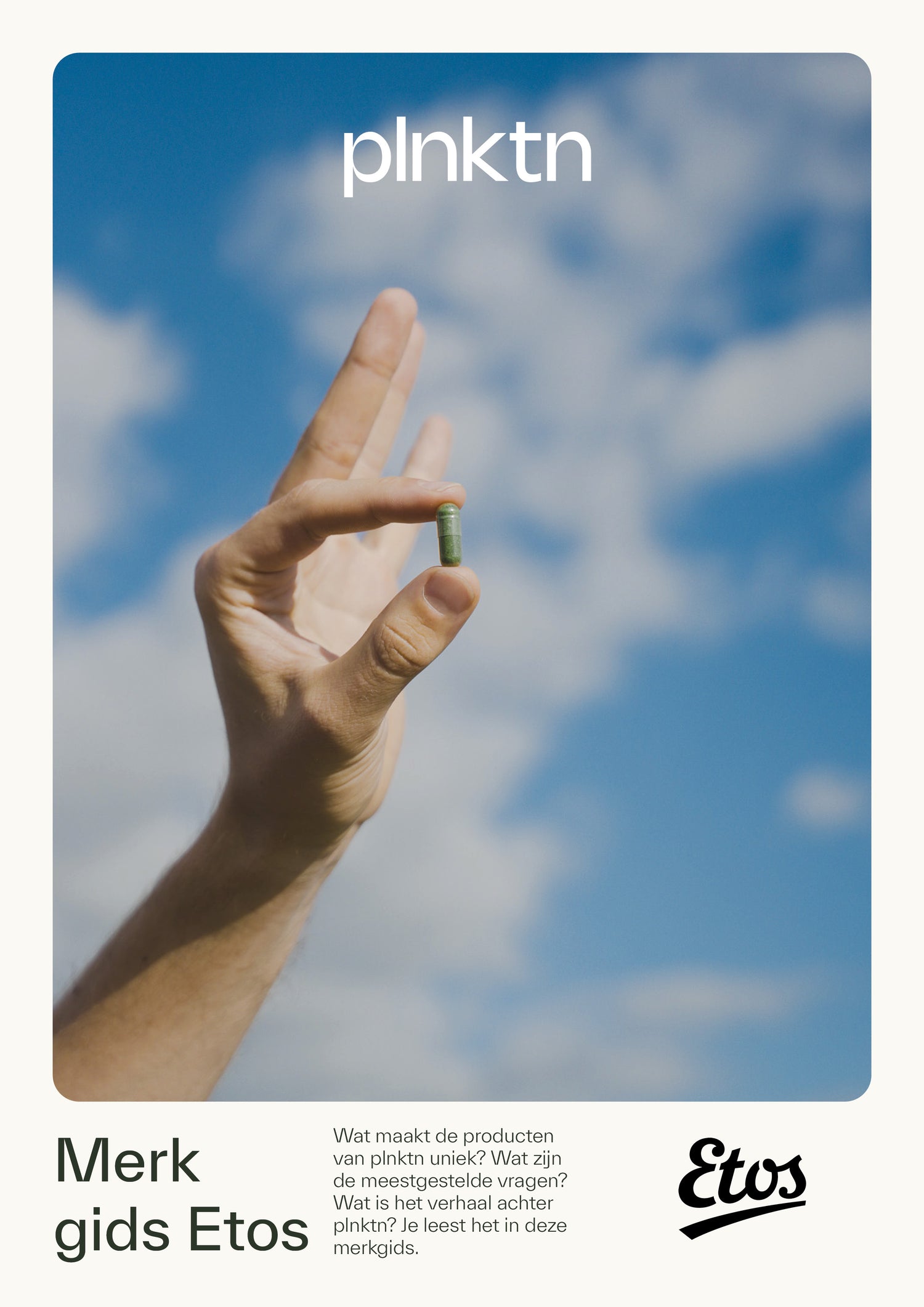
Brand guide Etos
What makes plnktn products unique? What are the most frequently asked questions? What is the story behind plnktn? You can read all about it in this product guide.
Scroll down for helpful product videos about plnktn!

Did you know, for example, that all plnktn products are plant-based? And that fish actually don't produce Omega-3 at all? Do you have more questions about plnktn products as a result of these videos, questions in the store, or for other reasons? Feel free to contact us; we'd love to hear from you. We can be reached daily via info@plnktn.com and via Instagram DM @plnktn_official.
Product explanation: Plankton Capsules, Omega-3, Magnesium & Vitamin D3
Did you know, for example, that all plnktn products are plant-based? And that fish actually don't produce Omega-3 at all? Discover all about it in the videos below. Fun fact: plnktn's magnesium comes from a 100% natural source. No synthetic fillers! Discover what else distinguishes plnktn and how we answer the most frequently asked questions in stores.
Collapsible content
What is the difference between plankton and other food products?
Plankton stands out for its unprecedented nutritional density. Simply put, this means: a lot of nutrients from a small amount. With just 2 grams of this pure product per day, you can already make a difference.
Should I take plankton every day?
Nothing is mandatory, of course! However, we do recommend a maintenance dosage of 2 grams (4 capsules) per day as a supplement to a varied diet and a healthy lifestyle.
Can I take plankton as a replacement for other supplements?
Plankton contains many nutrients such as proteins, minerals, amino acids, and vitamins. As with any supplement, it is a supplement to a varied and balanced diet, not a replacement. We also call it a natural boost. For specific needs, additional supplements can be taken, such as vitamin D3, Omega-3, and Magnesium.
What are plankton capsules made of?
The capsules are made of HPMC (hypromellose). This is a polysaccharide (carbohydrate) extracted from plants & wood. This is also the most common way to make plant-based/vegan capsules. HPMC is known to be easily digestible.
Is plankton plant-based?
Yes, all plnktn products are plant-based and suitable for a vegetarian and vegan lifestyle. However, plankton may contain traces of fish and shellfish. This is because the algae mix contains 2 types of seaweed that are cultivated in the Oosterschelde (Zeeland).
Collapsible content
Why do I need Omega-3?
Omega-3 fats are polyunsaturated fatty acids. Scientific research shows that a minimum of 250mg of omega-3 is good for your heart, brain, and eyes (health claims approved by the EFSA).
How do I recognize an Omega-3 deficiency?
An Omega-3 deficiency is not easily linked to concrete symptoms; this type of research is still in its infancy. Therefore, it is always advisable to consult a general practitioner if you have complaints. Given that Omega-3 contributes to a healthy nervous system, we see that symptoms such as concentration problems, poorer vision, and dry eyes are more common (source: IVG)
How much Omega-3 do I need per day?
The Health Council advises adults to consume 200 mg of Omega-3 from fish daily. Do you eat little to no fatty fish? One capsule of plnktn algae oil contains 250 mg DHA and 50 mg EPA, making it a good (and responsible) substitute!
Do Omega-3 from algae taste and smell like fish?
Whether fish taste like algae is the real question. The capsules have a specific taste and smell linked to the ocean. Burping, as with fish oil, rarely or never occurs. This usually has to do with the quality of the fish. And that's not in there :)
How is Omega-3 best absorbed?
Plnktn's Omega-3 capsules are algae oil-based and fat-soluble. Therefore, take them with a meal containing some fat, such as peanut butter or avocado.
Collapsible content
What makes plnktn magnesium unique?
Plnktn magnesium comes from the algae Ulva Lactuca (Sea Lettuce), a natural and organic source of magnesium. Many supplement brands use chemical compounds for their magnesium. We, on the other hand, use the form of magnesium that you also find in your other food, namely the natural form.
Does plankton magnesium have a relaxing effect?
Plnktn magnesium is a natural form derived from algae. It maintains your daily magnesium needs and is well absorbed by the body because no synthetic fillers are used. Magnesium contributes to various processes in the body, including the support and maintenance of strong muscles and bones and the production of proteins in the body. Additionally, magnesium can support the production of the sleep hormone melatonin, which is why it is also used as a supplement for sleep and relaxation.
How do you recognize a magnesium deficiency?
Because magnesium is found in many everyday products, such as vegetables, whole-grain and grain products, dairy, and nuts, a magnesium deficiency is rare. For example, in the Netherlands, 1-2% have a magnesium deficiency, which can potentially result in muscle cramps (source: RadboudUMC).
What form is the magnesium in?
Magnesium in Ulva lactuca is present in its free form, as a loose magnesium ion.
This free form of magnesium is bound to chlorophyll in Ulva lactuca. In the digestive tract, this bond with chlorophyll is broken, resulting in the release of magnesium in its free form, which can then be directly absorbed by the body. With high bioavailability of magnesium, our product can contribute to muscle and bone health and promote energy metabolism.
Collapsible content
What makes vitamin D from plants unique?
Our vitamin D3 comes from algae and is plant-based. Unlike many other supplements, whose source is unclear (often synthetic) or extracted from animal fats. Additionally, it also contains 250 mg of Omega-3 DHA. Omega-3 fatty acids are good for your heart, brain, and eyes.
How much vitamin D does a person need?
The recommended daily allowance (RDA) is 10 mcg per day. plnktn vitamin D contains 20mcg, 200% of the daily allowance.
What forms of vitamin D are there and which one should I take?
There are both animal and plant-based forms of vitamin D. Plnktn's vitamin D3 is fat-soluble and is extracted from algae oil, making it plant-based. Vitamin D3 is better absorbed in combination with fatty foods. To promote absorption, this capsule is oil-based.
Plnktn & Etos believe in the power of algae
Blog posts
View all-
What is the difference between spirulina and ch...
Spirulina and chlorella are often mentioned together. They are both microalgae and are used as a dietary supplement. Yet, their structures are fundamentally different. The difference lies in their structure,...
What is the difference between spirulina and ch...
Spirulina and chlorella are often mentioned together. They are both microalgae and are used as a dietary supplement. Yet, their structures are fundamentally different. The difference lies in their structure,...
-
Fish oil vs. algal oil: what's the difference?
Fish oil vs. algae oil is a comparison you often encounter when delving into omega-3. These two sources ultimately deliver the same fatty acids but reach your diet through different...
Fish oil vs. algal oil: what's the difference?
Fish oil vs. algae oil is a comparison you often encounter when delving into omega-3. These two sources ultimately deliver the same fatty acids but reach your diet through different...
-
What is algal oil?
Algae oil is a plant-based oil derived from microalgae (Schizochytrium sp.) and a natural source of omega-3 fatty acids. More and more people are choosing omega-3 algae oil as a...
What is algal oil?
Algae oil is a plant-based oil derived from microalgae (Schizochytrium sp.) and a natural source of omega-3 fatty acids. More and more people are choosing omega-3 algae oil as a...